Japan has been semi-isolated for centuries. The barriers are obvious: an ocean, the language, and the use of not one but three writing systems. Isolation, over time, shapes culture. For millennia, survival depended on the resources of a relatively small archipelago and the waters that surrounded it. The result was a society that prized co-operation over individualism, communal contribution over personal ambition, and resource stewardship over waste. Sharing, helpfulness, politeness, and the avoidance of conflict became not just virtues but necessities.

Of course, it probably helped that, in bygone times, a samurai was legally entitled to kill a peasant for lack of proper respect. Nothing encourages adherence to social etiquette quite like the possibility of immediate death. Formal greetings and correct behaviour became deeply codified.
The internet has breached that semi-isolation. Smartphones, Google Maps and, perhaps most importantly, Google Translate have thrown open the gates to the self-guided Western visitor.
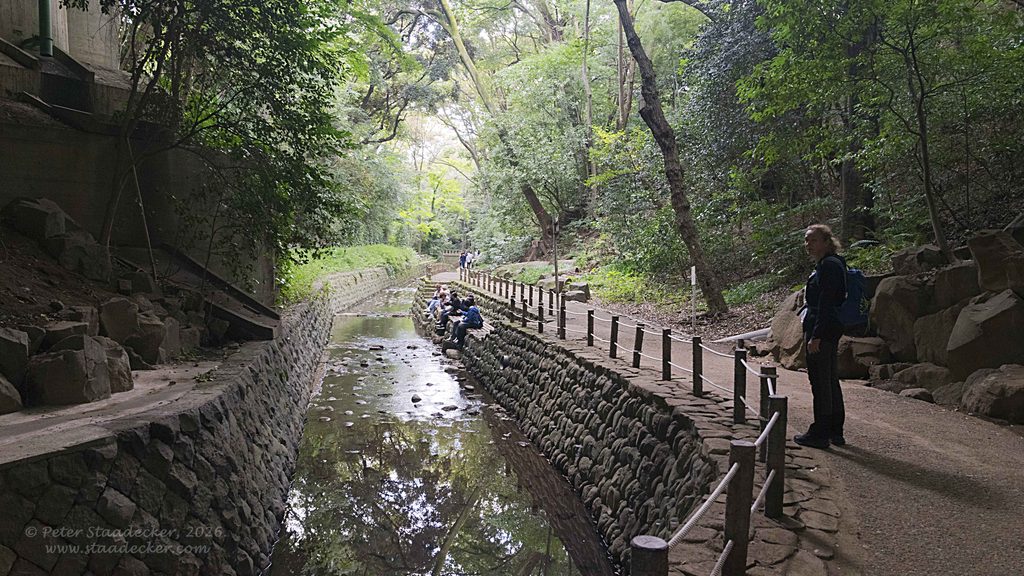
Which is how Mrs. S. and I found ourselves in Tokyo setting out to explore a modest nature trail called Todoroki Ravine, a place more frequented by locals than Westerners.
Getting there from downtown Tokyo typically takes an hour and three different subway lines. By the time you emerge at the Todoroki subway station, the feel of tourist Tokyo – wall-to-wall people, modern skyscrapers, flashing lights – has changed to little streets and little houses.
Here, the subway runs above ground between tiny back gardens, narrow alleyways and low-rise apartment buildings. Schoolchildren wait patiently at level crossings as barriers descend, lights flash, and alarm bells clang their rhythmic bing, bing, bing before allowing them to continue on their way. The shops are scaled accordingly. A bakery barely has room for four customers. A Seven-Eleven advertises milk on posters propped out on the pavement. A grocery store offers parking for exactly two cars. Tomod’s Pharmacy spills so many displays onto the sidewalk that I wonder whether it stocks more products outside than in.
The streets narrow. Sometimes the “sidewalk” is simply a painted stripe along the roadside. People walk. Mothers pedal bicycles carrying, impossibly, two toddlers at once: one in a front seat, one behind, each beneath a little rain hood. Delivery scooters trundle past at an unhurried pace. Cars are a rarity.
Tokyo may be one of the world’s largest cities, a metropolitan region of some 40 million people, but here in Setagaya Ward, urgency feels as though it has been shoved aside.
Which brings us to the misunderstanding.
I was navigating with Google Maps on my phone, held in my right hand. This meant that every so often I would stop, hesitate, or abruptly reverse direction. Mrs. S., recognising the hazards of walking within bumping distance of a man who believes he knows where he’s going because of a tiny blue dot, wisely walked several paces behind me.
Whenever I changed direction, I would signal back to her with my free hand. Palm out waist high, I would wave left or right to indicate our next turn.
At one such junction, perhaps ten or fifteen paces ahead of Mrs. S., I gave a leftward wave as I rounded a corner.
Coming towards me was a distinguished-looking Japanese gentleman.
Greying hair. Business suit. Walking stick.
I don’t recall whether he wore a tie, but if he did, it should have been a bow tie. Everything about him suggested a retired councillor, retired senior businessman, or some similarly respected member of the community. He walked with purpose and dignity, not slowly exactly, but with the air of a man who had long ago ceased rushing anywhere.
As I made my left-turn signal, he stopped.
Not slowed. Stopped.
It was extraordinary. Like watching a stately ocean liner go from full speed ahead to dead still in an instant.
Then he bowed.
Deeply.
When he straightened, he smiled at me with such warmth and sincerity that it genuinely startled me.
There was only one thing to do.
I stopped, bowed equally deeply, and attempted to return a smile worthy of the one I had just received.
We exchanged an additional, subtle inclination of the head, then each continued on our separate ways.
A few seconds later, Mrs. S. rounded the corner, having witnessed none of it.
It’s a ludicrously insignificant incident. Yet it has stayed with me, perhaps because of the extraordinary civility of the encounter, perhaps because of the genuine warmth of that smile.
Or perhaps because of the unanswered question.
The old gentleman had clearly mistaken my directional wave for a greeting.
But what did he think afterward?
Does he occasionally remember the strange foreigner who seemed so delighted to see him?
And does he still wonder, from time to time:
From where do I know that man?
***